

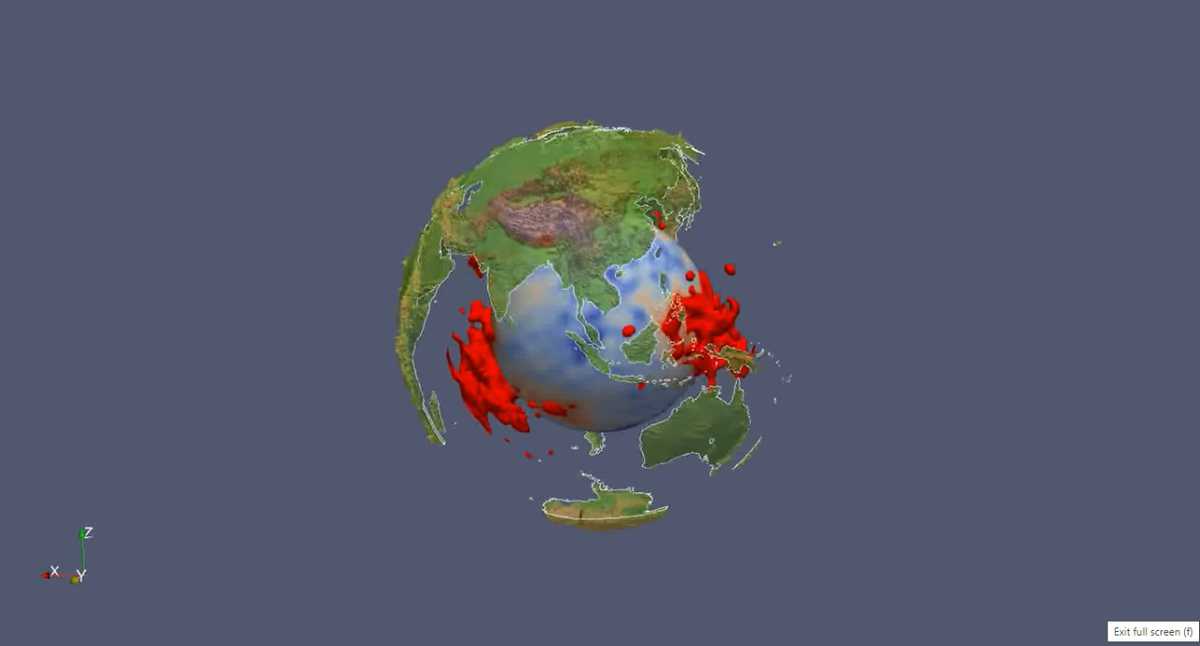
The new discovery indicates two spots located on the sides of the earth. This red spot is found under the Pacific Ocean. The FlightTounder portal explains that Tusso is the name of another place on the far right of the planet, below Africa and much of the East Atlantic Ocean..
Scientists refer to these two findings as the “Great Low-Speed Shear Provinces” (LLVSPs or LLVPs), but prefer to call them Jason and Tuso until they know exactly what they are and what they do.
Both structures rise from the base of a solid rock about 1,800 miles thick. The movement of these blobs does not come as a surprise to geologists, as solid objects can flow.
as well as, Such structures are believed to connect the boundary between the earth’s core and mantleThere they receive heat and therefore get more refreshed.
As McNamara (2019) collects, some scientists have been surprised by this finding because it is not uncommon to find something new in the earth. The University of Oslo explains the findings: “Hotspot lava, kimberlights, and large volcanic eruptions (LIPs) are superficial manifestations of plumes that mark plate tectonics, creating new plate boundaries and causing rapid climate change and extinction.”
As mentioned in the magazine Science, Jason and Tusso have been structures that have accumulated over the years, “from the beginning of plate tectonics” when the subducting slab began to enter the lower mantle via 660-D. “They are heaps of oceanic crust (SOC) that have accumulated throughout Earth’s history.”.
These structures “act as thermal insulators, effectively concentrating heat transfer from the core to the mantle via the conductor at the edges of the LLSVPs. There SML material dominated thermal diapers expand and rise into plumesThis explains why LIPs project to the margins of LLSVP.
These spots are thought to be antipodal, meaning that the center of their mass is aligned with the Earth’s axis, which rotates at the optimal moment of inertia. This explains why structures remain stable during the Earth’s rotations, where they exist.”.

Prone to fits of apathy. Unable to type with boxing gloves on. Internet advocate. Avid travel enthusiast. Entrepreneur. Music expert.