
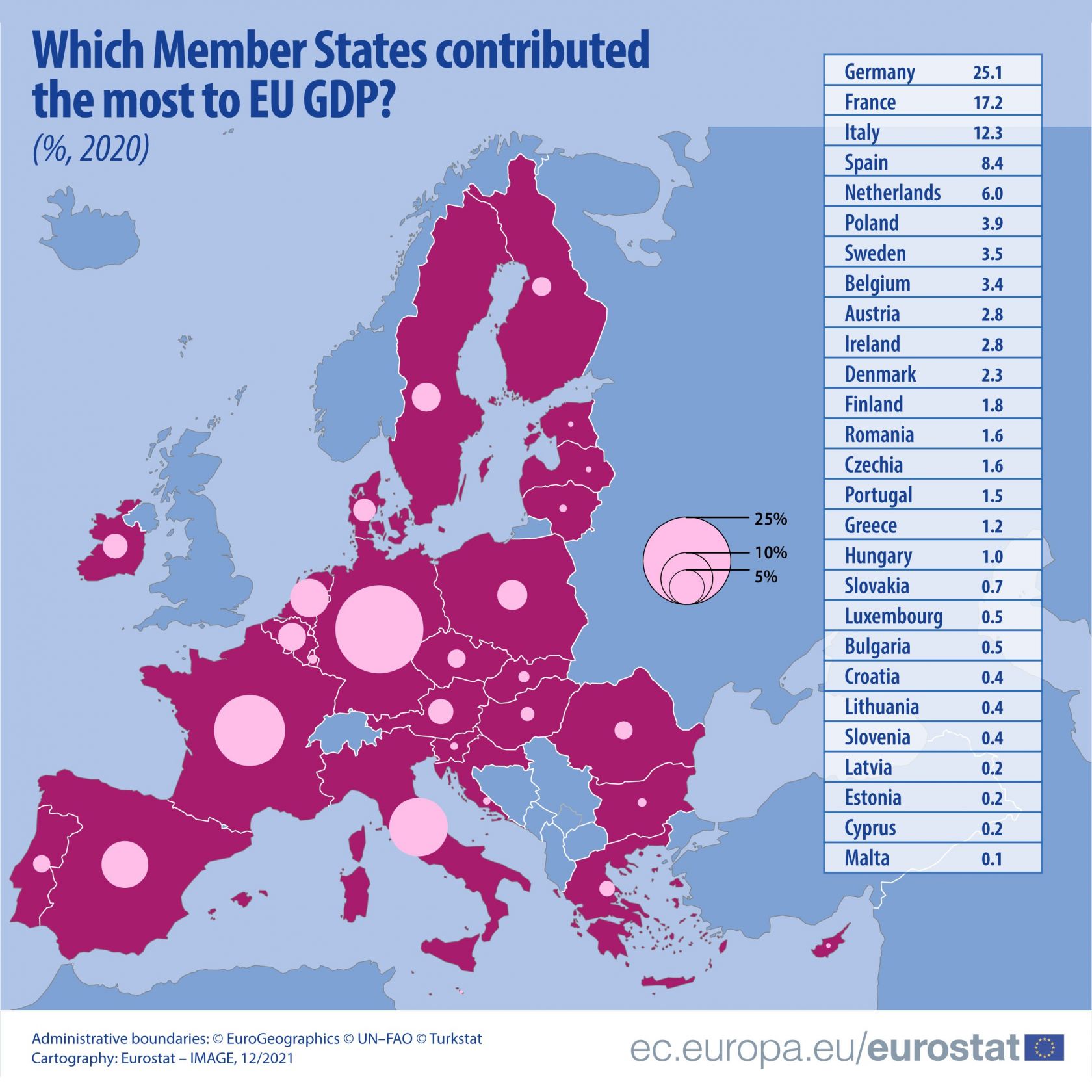
Portugal’s share of total GDP with the European Union will remain at 1.5% by 2020, while the German economy will grow to 25.1%.
The European Union’s gross domestic product (GDP) is projected to decline to .4 13.4 billion by 2020 due to the impact of the epidemic. Within a year, the economy was down 5.9% due to Kovid-19, the first decline since 2009 (-4.3%). However, not all member states have the same impact.
In the case of Germany, the largest economy in the European block, the GDP burden will fall from 24.8% in 2019 to 25.1% in 2020, and the German economy will be lower than the European average. France has 17.2% of the three largest economies in the European Union and Italy 12.3%.
This ranking of GDP (so far) by EU countries is consistent with the ranking of countries by population. In other words, the countries with the largest economies are the most populous countries, not surprisingly. This trend has been confirmed in the fourth place with Spain (8.4%), but in the fifth place it is not correct.
This is where the Netherlands appears, with 17.4 million inhabitants, 6% ahead of Poland, which is 3.9% of Europe’s 37 million people. This is because the Dutch per capita GDP is much higher than the Polish per capita GDP.
Portugal also does not look good from this point of view: it retains 1.5% of its weight, but ranks 14th, according to demographics, making it the tenth largest country in the European Union. The size of the Portuguese economy is surpassed by smaller populous countries such as the Czech Republic, Sweden, Denmark, Austria and Ireland. But it is above Greece (with a larger population than Portugal).
At the bottom of the list are member states that represent less than 1% of European GDP: Malta, with only 0.1%. Estonia, Cyprus and Latvia follow with 0.2%, followed by Croatia, Lithuania and Slovenia at 0.4%, followed by Bulgaria and Luxembourg at 0.5% and Slovakia at 0.7% despite having the highest per capita GDP.

Prone to fits of apathy. Unable to type with boxing gloves on. Internet advocate. Avid travel enthusiast. Entrepreneur. Music expert.