

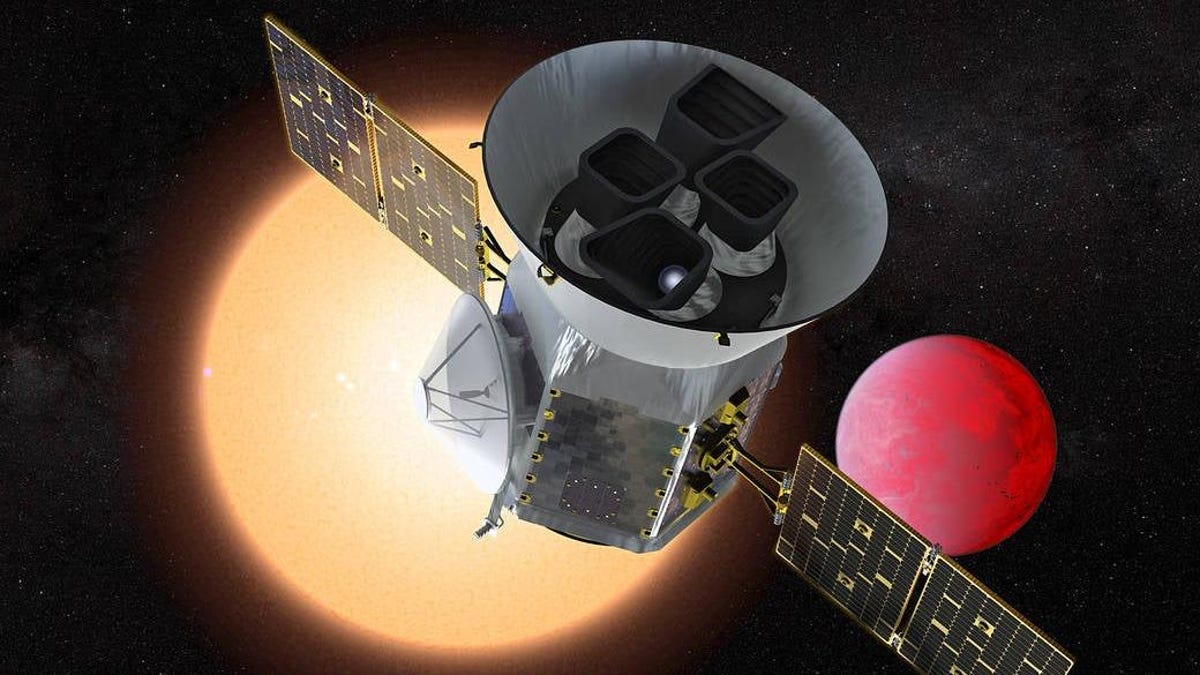

While scanning thousands of stars to search for exoplanets, NASA’s Transiting Exoplanet Survey Satellite (TESS) On Monday I entered safe mode. It is not yet clear what happened to the probe, but engineers are working to revive Planet Hunters.
The spacecraft is stable, but initial investigations show a computer malfunction, NASA said Announcement Wednesday. The team behind the mission is still trying to figure out what happened to the spacecraft, but TESS may have entered safe mode in response to resetting the flight computer.
As a result, TESS entered a stable configuration Its scientific activities have been suspended for the time being. Any scientific data collected by the spacecraft but not yet sent to ground control is stored on the satellite. “The recovery process and investigations to resume normal operations are underway and may take several days,” NASA wrote in a statement.
Launched in 2018, TESS detects Planets outside our solar system, the mission is designed to survey thousands of stars and identify potential planets in orbit around them. TESS observes a star and measures the slight dip in brightness caused by a planet passing in front of it from the spacecraft’s perspective.
TESS has so far used the transit method to discover more than 250 exoplanets, with thousands of candidate exoplanets still awaiting confirmation. The spacecraft was designed to last for two years but managed to survive. Hopefully this last blemish isn’t too much to worry about.
G/O Media may receive commission
TESS followed Kepler missionA space telescope launched in 2009 has discovered more than 2,600 planets in nearly 10 years in orbit. The discovery of exoplanets fuels our curiosity about whether another Earth-like planet exists somewhere in the Milky Way and whether life on Earth could replicate itself in the wider universe.
More: NASA’s newest Planet Hunter will do what Kepler couldn’t

Prone to fits of apathy. Unable to type with boxing gloves on. Internet advocate. Avid travel enthusiast. Entrepreneur. Music expert.