

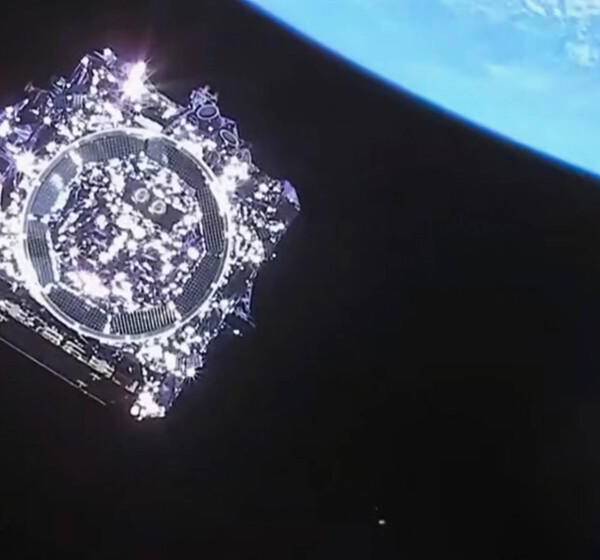
NASA Administrator Bill Nelson announced on Wednesday that the U.S. space agency will release on July 12 “the deepest picture ever taken of our universe,” thanks to the recently launched James Webb Space Telescope.
“If you think about it, it’s the farthest mankind has ever seen,” Nelson told a news conference at the Science Institute of the Space Telescope in Baltimore, home to the $ 10 billion Observatory, which opened in December last year. It orbits the Sun at a distance of 1.5 million kilometers from the Earth.
An engineering marvel, the web telescope can look into space more than any other telescope has ever done, thanks to its large mirrors and infrared focusing equipment, which allow it to pass through cosmic gas and dust.
“It’s going to explore objects in the solar system and the atmosphere of exoplanets orbiting other stars, giving clues as to whether or not their atmosphere is similar to ours,” Nelson said by phone from his Kovid isolation.
“It may answer some of our questions: Where did we come from? What else is there? Who are we? Of course it will answer questions we do not yet know.”
The infrared capabilities of the Web telescope allow us to look back more than the Big Bang 13.8 billion years ago.
As the universe expands, light from the first stars changes from the ultraviolet wavelength in the visible spectrum, corresponding to infrared wavelengths ready to detect the web at unprecedented resolution.
Currently, the farthest observations of the cosmos are 330 million years after the Big Bang, but with the web, astronomers believe they could easily cross the line.
20 years of life
In another piece of good news, NASA Administrator-in-Charge Pam Melroy said that thanks to the efficient launch of NASA partner Arians Space, the web telescope can continue to operate for 20 years.
“Those 20 years will not only allow us to go deeper into history and time, but also go deeper into science, because we have the opportunity to study, grow and make new observations,” the director said.
NASA intends to share the first web spectroscopy of a distant planet or exoplanet on July 12, said NASA Principal Scientist Thomas Zurbuchen.
Spectroscopy is a tool for analyzing the chemical and molecular structure of distant objects, and also allows a planetary spectrum to capture their properties, such as the presence of water and the appearance of their soil.
“From the beginning, when we look at the starry sky, we look at those worlds that awaken us at night,” Surbuchen added.

Prone to fits of apathy. Unable to type with boxing gloves on. Internet advocate. Avid travel enthusiast. Entrepreneur. Music expert.