

NASA plans to add at least one crewed lander to the Moon’s south pole in the Artemis program.
The project was first proposed in March this year and officially announced on September 16, with NASA asking private companies to develop more crewed lunar landers to boost its capabilities.
According to the roadmap, the Artemis lunar exploration program is divided into several phases. After the uncrewed Artemis I mission, astronauts will complete an orbit around the moon in 2024 on the Artemis II mission and land on the moon’s south pole on the Artemis III mission in 2025 or 2026.
“We expect the two companies to develop landers under NASA’s guidance to safely land astronauts on the lunar surface,” said Lisa Watson-Morgan, Systems Program Manager, Crew Landing at Marshall Space Flight Center. “This will help build the foundation for long-term deep space exploration.”

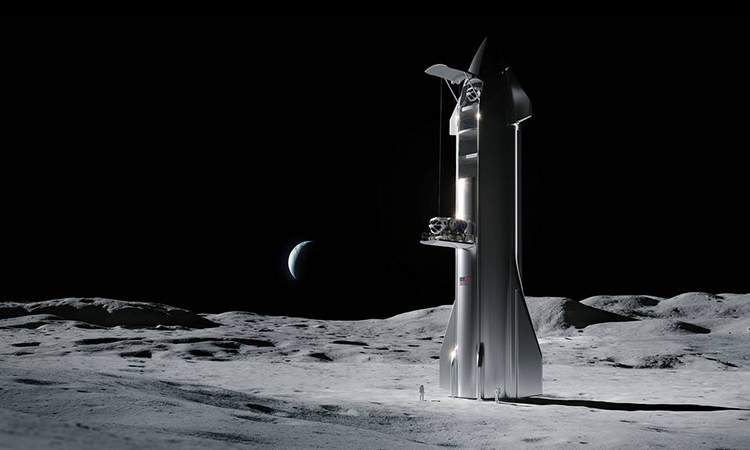
A simulation of the Moon Lander built by SpaceX for the Artemis III mission. Image: SpaceX
NASA is working to establish a permanent human presence below the surface and in lunar orbit. In 2021, the agency announced that SpaceX’s Starship had been selected as the lander for its first surface mission, Artemis III. Therefore, SpaceX will not be allowed to bid for the contract to build a new lander.
Other companies can submit their ideas until November 15, 2022. Selected participants will have to make two flights to the lunar surface, one uncrewed and one crewed. The contract NASA signed with SpaceX for the first lander has similar requirements.
“Partnering with U.S. companies to do that allows us to leverage NASA’s knowledge and expertise for technological innovations that will sustain a long-term human presence on the Moon.” “, added Watson-Morgan.
NASA is scrambling to prepare for the Artemis I mission, which will use a Space Launch System rocket to send the Orion spacecraft to lunar orbit and back. The flight was originally scheduled to take off on August 29 but was delayed several times due to technical glitches. The next launch attempt is underway September 27.
Don Duong (O place)

Prone to fits of apathy. Unable to type with boxing gloves on. Internet advocate. Avid travel enthusiast. Entrepreneur. Music expert.