

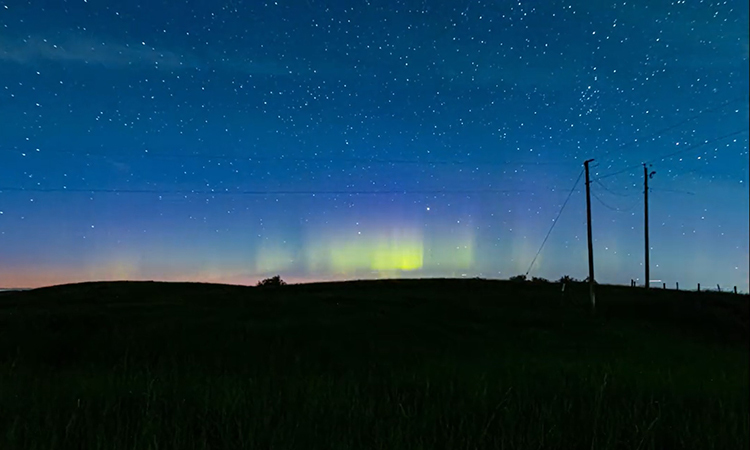
On July 7, a crack in the Earth’s magnetic field appeared and remained open for 14 hours, creating strong winds and an aurora.
Discontinuities in the Earth’s magnetic field are caused by a rare phenomenon called the co-rotation interaction (CIR) magnetic field from the Sun. CIRs are large plasma structures that form in the low- and mid-latitude regions of the heliosphere—the region surrounding the Sun that includes the solar magnetic field and solar wind—when the fast and slow solar winds interact. Like coronal explosions (CMEs), CIRs launched from the Sun to Earth can contain shock waves and compressed magnetic fields that cause special space weather phenomena, including auroras.

On July 7, the Northern Lights appeared in the sky. Video: Harlan Thomas
This time CIR entered the Earth’s magnetic field earlier on 7/7 and caused a long-lasting G1-class geomagnetic storm. Analysts at the National Oceanic and Atmospheric Administration (NOAA) believe a CME was embedded in the solar wind before the CIR.
It is not uncommon for cracks to appear in the Earth’s magnetic field. The magnetic field acts as a shield to protect the blue planet from storms launched from the Sun. Scientists once thought they opened and closed relatively quickly, but later discovered they could stay open for hours.
We found that Earth’s magnetic shield is almost as drafty as a house with the windows open during a storm. The house deflects most of the storm, but similarly, the Earth’s magnetic shield carries most of the force in space. storms, but still some energy flows through the cracks, sometimes enough to cause problems for a satellite, electrical systems and radio communications,” said Harald Frey, lead author of a 2003 study of Earth’s magnetic field.
Saturday’s event did not appear to cause power outages or radio communications, but instead, bright auroras appeared across Canada and the United States. The Sun is gradually entering the most active phase of the solar cycle (July 2025) and has many unusual activities. Astronomy enthusiasts already have many opportunities to observe the aurora borealis, and the opportunities will only get bigger in the next 3 years.
Tu Tao (O IFL Science)

Prone to fits of apathy. Unable to type with boxing gloves on. Internet advocate. Avid travel enthusiast. Entrepreneur. Music expert.