

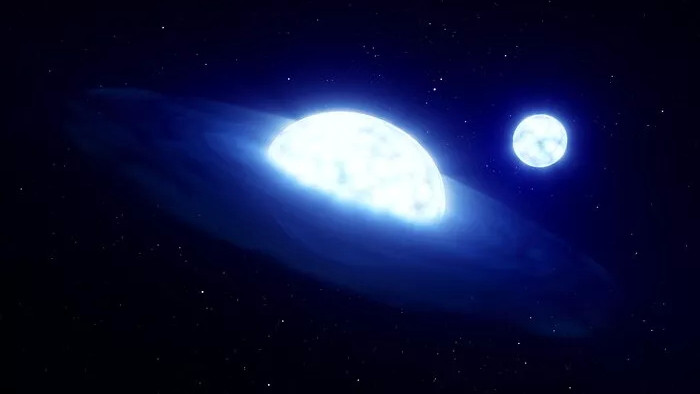
When astronomers announced in 2020 that there was a black hole in it, the telescopic galaxy HR 6819 made headlines. At a distance of only a thousand light-years from Earth, the Milky Way is the closest black hole ever found.
Researchers at the time wrote that the existence of a black hole was necessary to understand the motions of the two stars in the system, and that the black hole and one star orbited the other in a broad orbit.
Scientists have now written that they were wrong and that the black hole does not exist.
Dietrich Bade, an astronomer at the European Southern Observatory (ESO) and co-author of the study, said only one light spot containing the signs of two stars had been discovered before.
Because the two stars are similar in brightness and age, their masses are similar and orbit at high speeds.
“Since we have only seen a star orbiting some giant celestial body, we assumed this invisible giant was a third object, i.e. a black hole,” Bade said.
Other researchers suggest that there may be only two stars in the system, one of which was recently separated and is sometimes referred to as the Star Vampire. According to a recent issue of Astronomy and Astrophysics, the vampire’s weight has increased significantly, the Guardian wrote online.
In the new study, Badde and colleagues analyzed new data from two ESO telescopes, VLT and VLTI.
The results reject the idea of a black hole, but researchers are confident.
“A hijacked star is more exciting than a black hole because it is at a point where only a very small fraction of the total life of the system exists,” Bade said.
Since the “bite” of the vampire star has removed the opaque veil of thick outer layers, the star can show the interior of the sky, so we can scrutinize how the star generates the energy it emits and how it synthesizes new elements. , He added.
According to the scientist, when such elements are ejected, stellar dust can form not only new stars, but also planets and inhabitants.
Opening image: Illustration (ESO / L. Calçada)

Prone to fits of apathy. Unable to type with boxing gloves on. Internet advocate. Avid travel enthusiast. Entrepreneur. Music expert.