
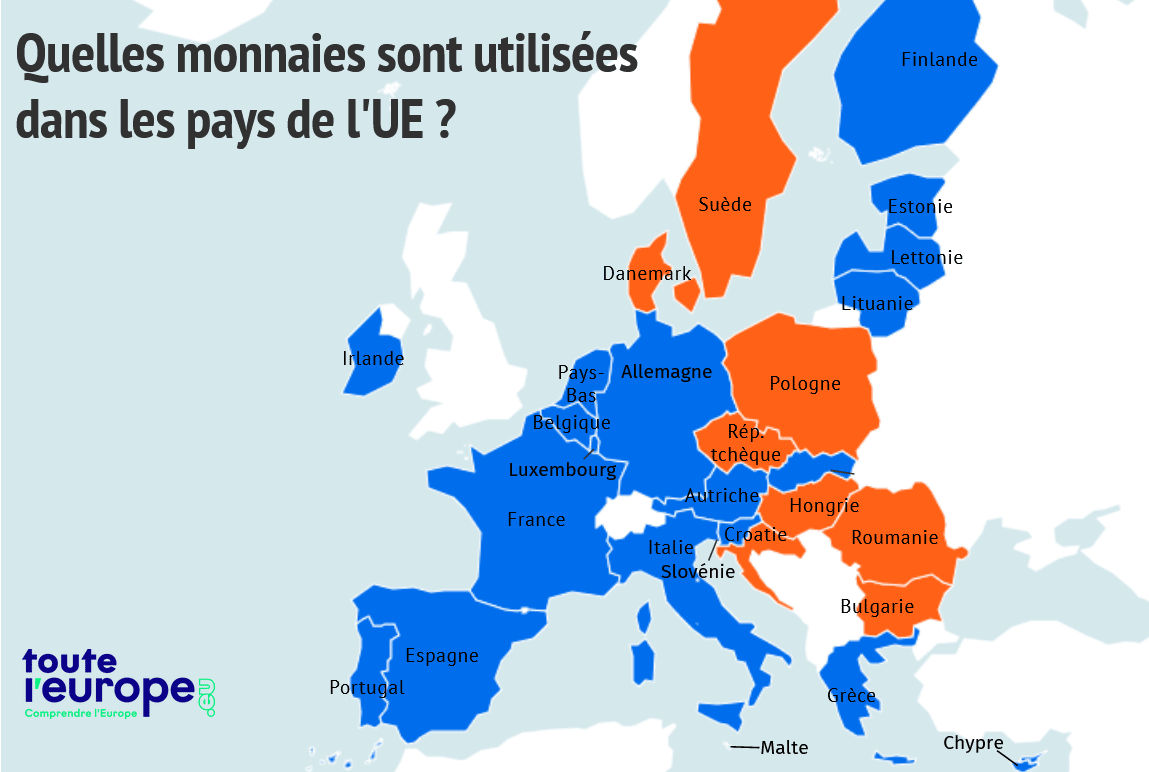
19 of the 27 member states of the European Union currently use the euro as their currency. Find out what currencies other European countries use.
Currently, 19 countries in the European Union use a single currency called the Euro. They are Germany, Austria, Belgium, Cyprus, Spain, Estonia, Finland, France, Greece, Ireland, Italy, Latvia, Lithuania, Luxembourg, Malta, Netherlands, Portugal, Slovakia and Slovenia.
On January 1, 2023, Croatia will also adopt the currency and become the twentieth member of the Eurozone.
Seven other member states currently use a different currency but are destined to adopt a single currency one day, except for Denmark, which has been granted an exemption.
On January 1, 1999, the euro was first introduced in dematerialized (literal) form in 11 member states of the European Union (Germany, Austria, Belgium, Spain, Finland, France, Ireland, Italy, Luxembourg, the Netherlands, and Portugal).
Its objective is to end the volatility of exchange rates between different national currencies.
Europeans had to wait until January 1, 2002 for euro coins and banknotes to be put into circulation and used.
List of currencies and their conversion rate to Euro:
(For currencies other than the Euro, the conversion rate stops on August 2, 2022)
Germany : Euro (since 1999)
Austria : Euro (since 1999)
Belgium : Euro (since 1999)
Bulgaria : Bulgarian lev (1€ = 1.96 leva)
Chypre : Euro (since 2008)
Croatia : Croatian Kuna (1€ = 7.51 Kuna) – Croatia will use the Euro from January 1, 2023.
Denmark : Danish krone (1€ = 7.45 Danish kroner)
Spain : Euro (since 1999)
Estonia : Euro (since 2011)
Finland : Euro (since 1999)
France : Euro (since 1999)
Greece : Euro (since 2001)
Hungary : Hungarian forint (1€ = 397 forints)
Ireland : Euro (since 1999)
Italy : Euro (since 1999)
Latvia : Euro (since 2014)
Lithuania : Euro (since 2015)
Luxembourg : Euro (since 1999)
Painted : Euro (since 2008)
The Netherlands : Euro (since 1999)
Poland : le zloty (1 € = 4.71 zloty)
Portugal : Euro (since 1999)
Czech Republic : Czech crown (1€ = 24.65 crowns)
Romania : Romanian Leu (1€ = 4.93 lei)
Slovakia : Euro (since 2009)
Slovenia : Euro (since 2007)
Sweden : Swedish crown (1€ = 10.4 crowns)

Prone to fits of apathy. Unable to type with boxing gloves on. Internet advocate. Avid travel enthusiast. Entrepreneur. Music expert.