

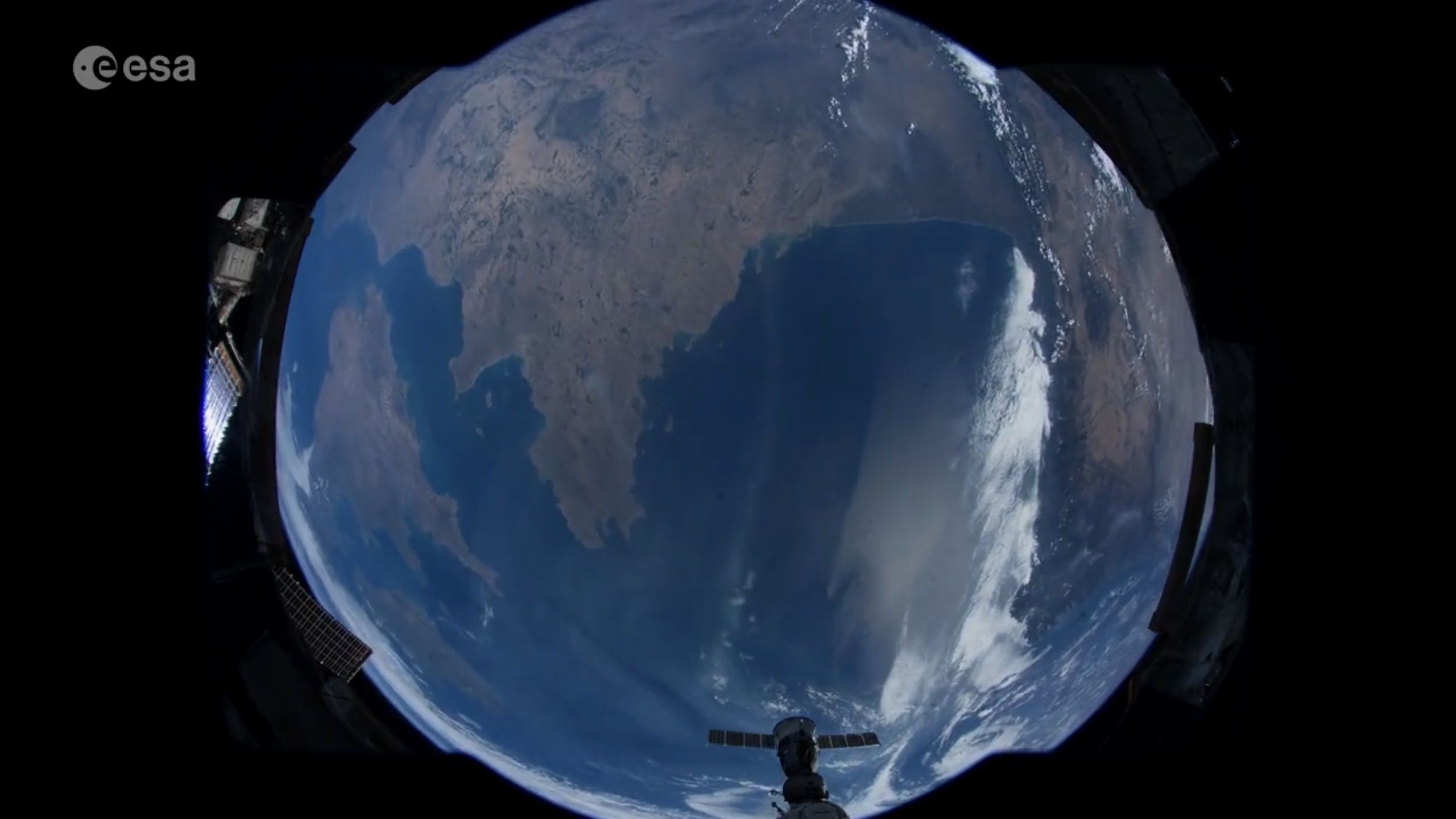
Italian astronaut Samantha Cristoforetti has just shared an amazing video of Earth captured with a fisheye lens from the ISS. The result which she posted on her Twitter account is amazing.
An astronaut on the International Space Station (ISS) has shared a rarely seen video showing our planet from horizon to horizon from the station’s outpost. The video captured by Italian astronaut Samantha Cristoforetti was made possible by recording Earth through a fish-eye lens. At nearly 7,000km, the video (below) begins just before Ireland before reaching the Horn of Africa, passing France, the Mediterranean islands, Sardinia, Sicily, the Nile and the Red Sea.
An incredible view of the earth
Astronaut Cristoforetti has been keeping his one million Twitter followers up to date on the activities on the space station since he reached orbit five months ago. ” Fly with me! From Ireland to the Horn of Africa through a fisheye lens ,” Cristoforetti wrote in a tweet alongside the video. ” It distorts the geometry a bit, but it allows me to show you almost every view we have from the space station from one horizon to the other! ” she says.
In addition to mentoring budding astronauts, she doesn’t hesitate to reveal stunning aerial photos of a moonlit Earth, a lunar eclipse from space, and an investigation into a strange light she spotted last week. on earth Cristoforetti even took time to recreate a moment from the hit space movie gravity of 2013.
The International Space Station has been in service for two decades and orbits the Earth at an altitude of about 408 km. On the station, two astronauts, including Thomas Pesquet, prepared a fully guided tour of the new Russian spacecraft module, which provides an unobstructed view of Earth.
Know that the ISS is not permanent. NASA plans to continue its operation until the end of 2030, after which the ISS will voluntarily send the ISS to crash land at Point Nemo (the sea pole of inaccessibility, i.e. the farthest ocean from the surface of the surface of the Pacific Ocean).

Tv fanatic. Amateur food maven. Devoted webaholic. Travel lover. Entrepreneur. Evil writer. Beer guru.